The Hidden Lever in Your SIP: Why Keeping Your Investment Flat Is Costing You

You set up your SIP a few years ago. ₹10,000 every month like clockwork. You're disciplined about it, maybe even smug about it. And you should be most people don't have the patience.
But here's the thing that keeps me up at night: that same ₹10,000 you're investing today? In 15 years, it won't buy half of what it does now. Not because your fund is underperforming. Because inflation is doing what it always does.
The Math That Nobody Talks About
Let's be honest. Your salary probably goes up most years. Some years 5%. Some years 10%. Maybe more if you switch jobs. Your lifestyle adjusts. You earn more, you spend a bit more, life goes on.
But your SIP? It stays exactly the same. Year after year.
You're essentially investing less each year in real terms. Inflation is quietly eroding your buying power, and you're not keeping pace.
It's like trying to run up an escalator while it's moving down. You're moving, sure. But you're fighting against something you can't see.
The Fix Is Simpler Than You Think
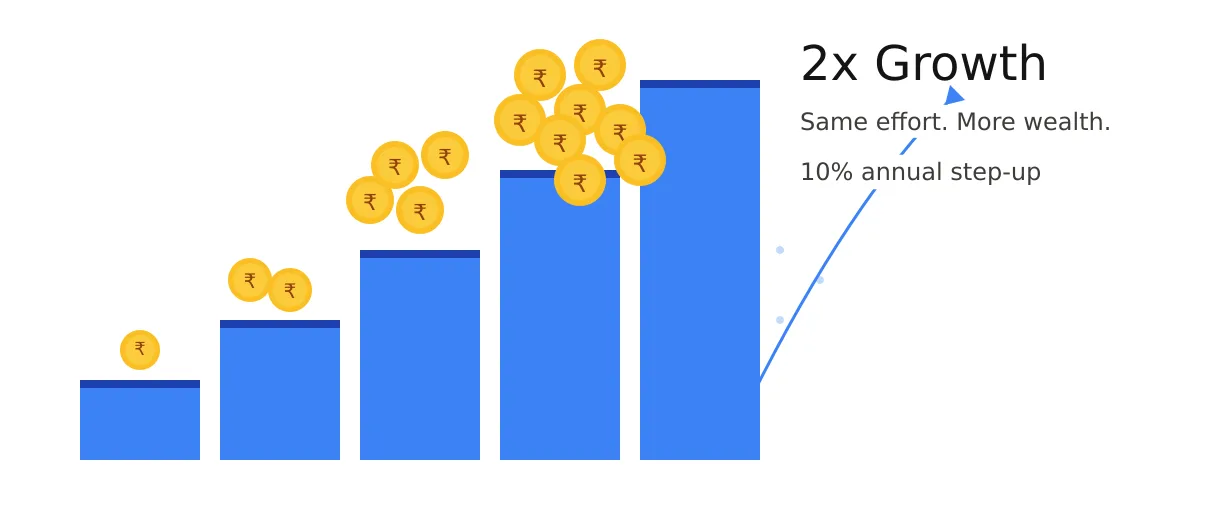
There's a small structural change that completely flips the math. It's called a step-up, and it's almost embarrassingly simple: increase your SIP amount by 10% at the end of each year.
That's it.
Most years, that's roughly in line with income growth anyway. You probably don't even notice it. It's ₹1,000 more per month in year two. ₹1,100 in year three. Nothing dramatic. But the compounding math? That's where it gets interesting.
The Numbers Are Ridiculous
Here's what happens over 20 years at a 12% annual return:
Static SIP: You invest ₹10,000 every month. No changes. After 20 years, you have roughly ₹1 crore.
Step-Up SIP: Same ₹10,000 starting point. But you bump it 10% each year. After 20 years, you have roughly ₹2.1 crore.
You didn't double your effort. You more than doubled your money. That's not extra hard work paying off. That's compound interest meeting automation and going absolutely nuclear.
The step-up forces your capital to scale alongside your earnings. You're not fighting inflation anymore you're exploiting it. You're deploying more money right when your compound growth machine is running hottest.
Why This Matters (More Than You Think)
Most people focus on the interest rate. They stress about fund selection, market timing, whether they should switch funds. That stuff matters, but it's background noise compared to this.
A step-up is an automated inflation hedge. It's your silent partner ensuring you're not just saving for the future you're scaling for it.
The math is patient. The compounding is relentless. All you have to do is adjust your SIP by a percentage that probably already exists in your paychecks.
It's not flashy. It's not complicated. But I genuinely believe it's the most underused lever in personal investing.
Disclaimer: The views expressed are the personal opinions of the contributing practitioner and do not constitute investment consultancy or professional insights. Mutual Fund investments are subject to market risks — read all scheme-related documents carefully before investing.
Kapil Mundhra
Kapil Mundhra founded Niyati Financial Solutions in 2017 and hasn't looked back. He's a certified Mutual Fund Distributor focused on fundamental equity analysis the kind that takes time and doesn't rely on market noise. His "Middle Path" approach is straightforward: help people understand what they own and why, build for the long term, and skip the shortcuts. He writes about markets on Niyati Insights because he believes people deserve clarity, not jargon. Compliance and discipline aren't afterthoughts; they're how he works.
Discussion (0)
Please Sign In or Register to join the discussion.
No comments yet. Be the first to share your thoughts.